Supporting schools across Australia+61 488 011 176   |   steven@schoolincident.com.au
Operational readiness for every school

Prepared people make better decisions.

We transform emergency plans into practical, integrated systems that reduce the burden, stress and uncertainty on school staff. Whether you are a small remote school with 30 students or a large, sprawling metropolitan or multi-campus school, our Operational Readiness Framework can be scaled to support your environment, people, risks and resources.

Steven Dunn, Director of School Incident Solutions
25+ yearsIncident and crisis management experience
Every schoolRemote, regional, metropolitan and multi-campus
Integrated systemsPlanning, guidance, communication and training
Australia-wideOn-site and remote delivery
Our point of difference

A plan is only effective if people know how to use it.

We operationalise emergency plans through role-specific guidance, layered communication, induction systems, training and practical exercises.

01

Assess

Physical layout, community, operating environment, technology systems, student profile and unique risks, including bushfire, cyclone, lightning and hazardous materials.

02

Design

Collaborate with the school to design a school-specific Incident Management Program that is practical, flexible, adaptable and supports an all-hazards methodology.

03

Enable

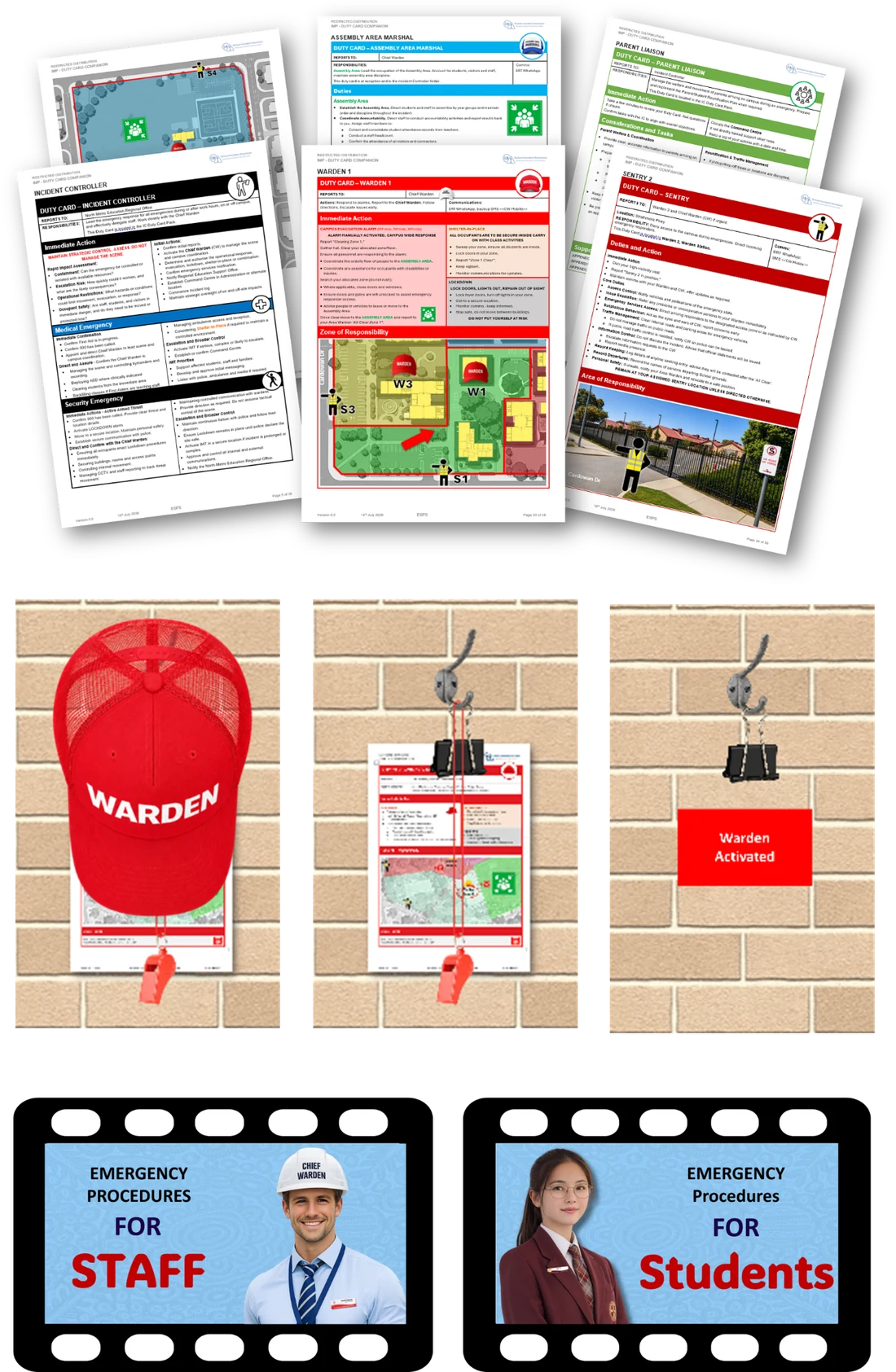
Provide role-specific guidance, duty cards, staff guides, Warden Stations and tailored alarm tones incorporating clear embedded voice annunciation.

04

Communicate

Layer audible tones, push messaging and visual notifications to support information flow between response teams and leaders.

05

Train

Build understanding through induction videos, practical training, drills and exercises.

06

Lead

Use best-practice leadership structures for strategic and operational incident management.

07

Improve

Apply observations, debriefs, leadership exercises, scenarios and procedure updates.

View the Operational Readiness Framework
From document to operational system

More than a plan.

Each element reduces cognitive load and places the right information in the right format at the point of need.

1

Role-specific guidance

Duty cards, staff guides and Warden Stations provide rapid access to clear actions.

2

Layered emergency communication

Audible tones, clearly annunciated voice instructions, push messages and emergency display screens reinforce the same response.

3

Induction processes

Staff, students and Early Years learners understand their emergency responsibilities from commencement rather than waiting until the next scheduled emergency drill.

“We do not create paperwork. We build capability.”
Prepared, confident and capable staff create safer and more secure outcomes for students.

Explore Our Services
Clear language. Consistent action.

Three primary emergency procedures.

Each procedure uses distinct language and dedicated alarm tones. The terminology is clear, concise and uncluttered. The visual language is consistent across the school and reinforced through evacuation diagrams, induction videos and emergency information panels.

Evacuate

Move occupants to the nominated Emergency Assembly Area or Muster Point.

Move to the emergency assembly area or muster point.

Shelter-in-Place

Move inside. Lock doors. Continue with class activities.
The initial all threats and hazards response.

Lockdown

Lock doors. Lights out. Remain out of sight.

Active threat. Immediate action required.
Layered emergency communication

One message. Multiple channels.

Layered alarm notification is strongest when delivered through audible alarm tones, push messaging, visual displays and digital communication systems.

Discuss Alarm Notifications
1
Audible
Distinctive alarm tones with clearly annunciated voice instructions.
2
Push
Messages to staff devices and supporting technology platforms.
3
Visual
Emergency display screens clearly communicating the current emergency procedure.
4
Operational
Highly visible duty cards, staff guides and Warden Stations.
Operational components

Designed to work together.

Duty Cards

Concise one-page, double-sided guides providing immediate role-specific actions during an emergency.

Warden Stations

Highly visible, accessible and ready to use. If a hat remains on the station, the role is vacant. Any trained staff member can retrieve the hat, review the duty card and undertake the role.

Induction Videos

Purpose-built content for staff, students and Early Years learners, supporting understanding from day one.

Alarm Tones

Distinctive tones with clearly annunciated voice instructions, aligned to push messaging and emergency display screens.

School-Specific Leadership

Clear Incident Management Team and Emergency Response Team structures designed for schools.

Review and Improvement

Drill observations, incident debriefs and leadership exercises keep the system current.

Steven Dunn
Why School Incident Solutions exists

It began in a pre-primary classroom.

While helping with Play-Doh in my son's classroom, I took part in a routine fire drill. The experience raised a simple question: if this is how the school prepares for a fire, what other systems are protecting my son?

That question became the catalyst for School Incident Solutions. Today, the same purpose guides every engagement: make emergency response practical, understandable and usable for the people responsible for protecting students.

Read Steven's Story
Trusted by school leaders

Practical systems. Clear outcomes.

“The integrated system has improved staff understanding of their roles and increased confidence in responding to emergency situations.”

Shani Andrews
Vice Principal, John XXIII College

“The systems and training brought greater clarity to staff roles, strengthened leadership coordination and increased overall confidence.”

Luise Lowndes
Vice Principal, Perth College

“The work enhanced flexibility in our response model and provided greater confidence across staff in understanding what to do and when.”

Fiona Johnston
Principal, St Hilda's Anglican School for Girls

Ready to strengthen your school's emergency preparedness?

Discuss your school's current arrangements, risk profile and operational readiness with Steven Dunn.

Book a Consultation